Savor
A mobile app designed to bridge generational gaps through family recipes
Rice Design-a-thon 2026
Role
Product Designer
Design interfaces
Design user flow
High fidelity prototyping
Team
Angela Jang (Designer)
Yuju Hong (UX Researcher)
Duration
Jan 30, 2026 - Feb 1, 2026
Skills
UI Design
Prototyping
Figma AI & MCP
Cursor
What I did
As the team’s product designer, I architected a scalable interaction system and led the end-to-end interface design for “Savor” within 36-hours, collaborating closely with my teammates. I was responsible for setting the overall design direction and delivering high-fidelity prototypes.
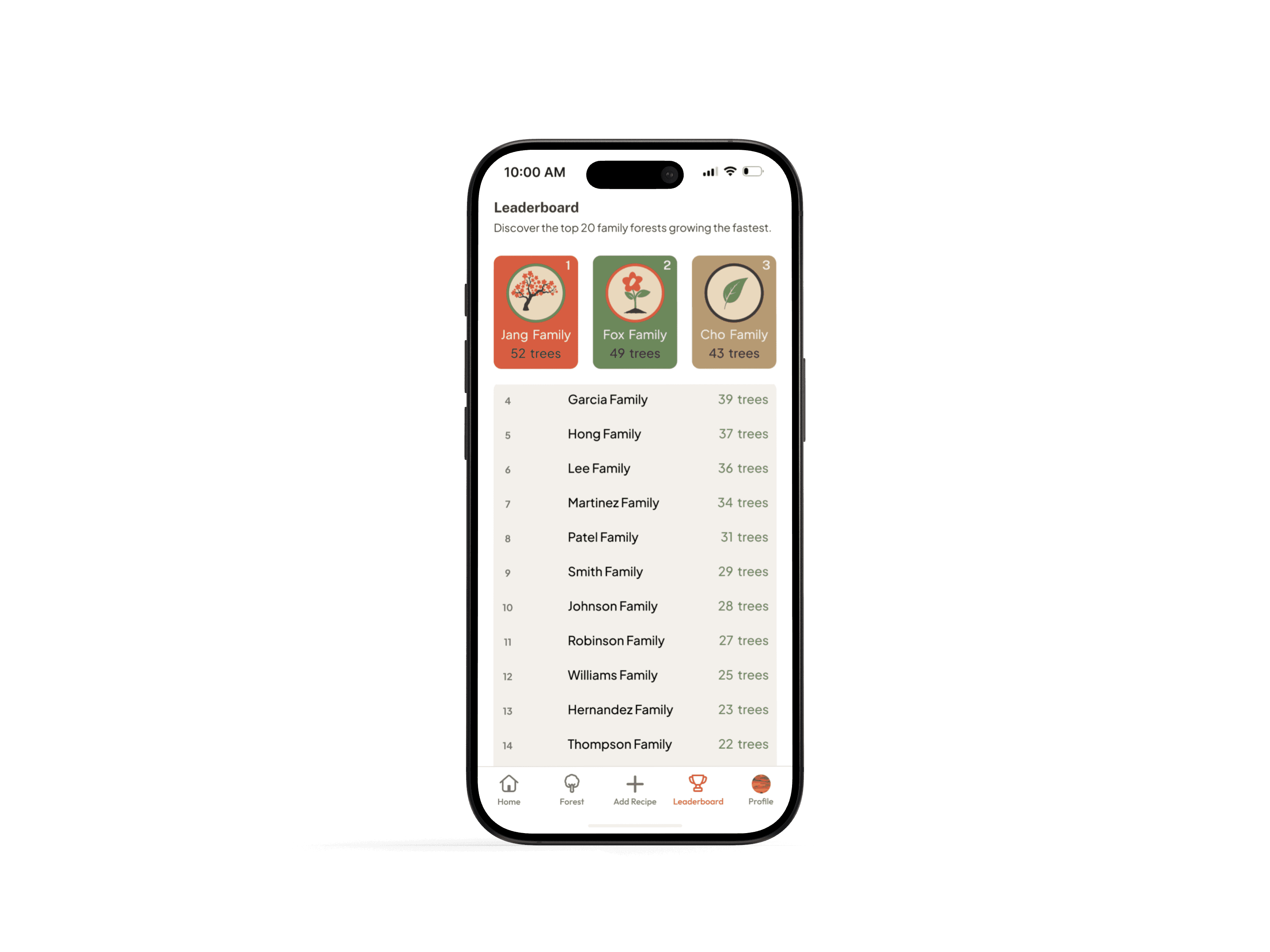
To test the system’s technical logic, I continued developing the project independently after the hackathon. Using Cursor and Figma MCP, I bridged the gap between design and code by building a functional React prototype. This allowed me to validate interaction patterns and assess technical feasibility in ways static mockups couldn’t capture.
Overview
Savor was created during Rice University’s Design-a-thon, a 36-hour design hackathon where participants were challenged to develop a solution within a limited timeframe.
Theme: Bridging generational gaps through design.

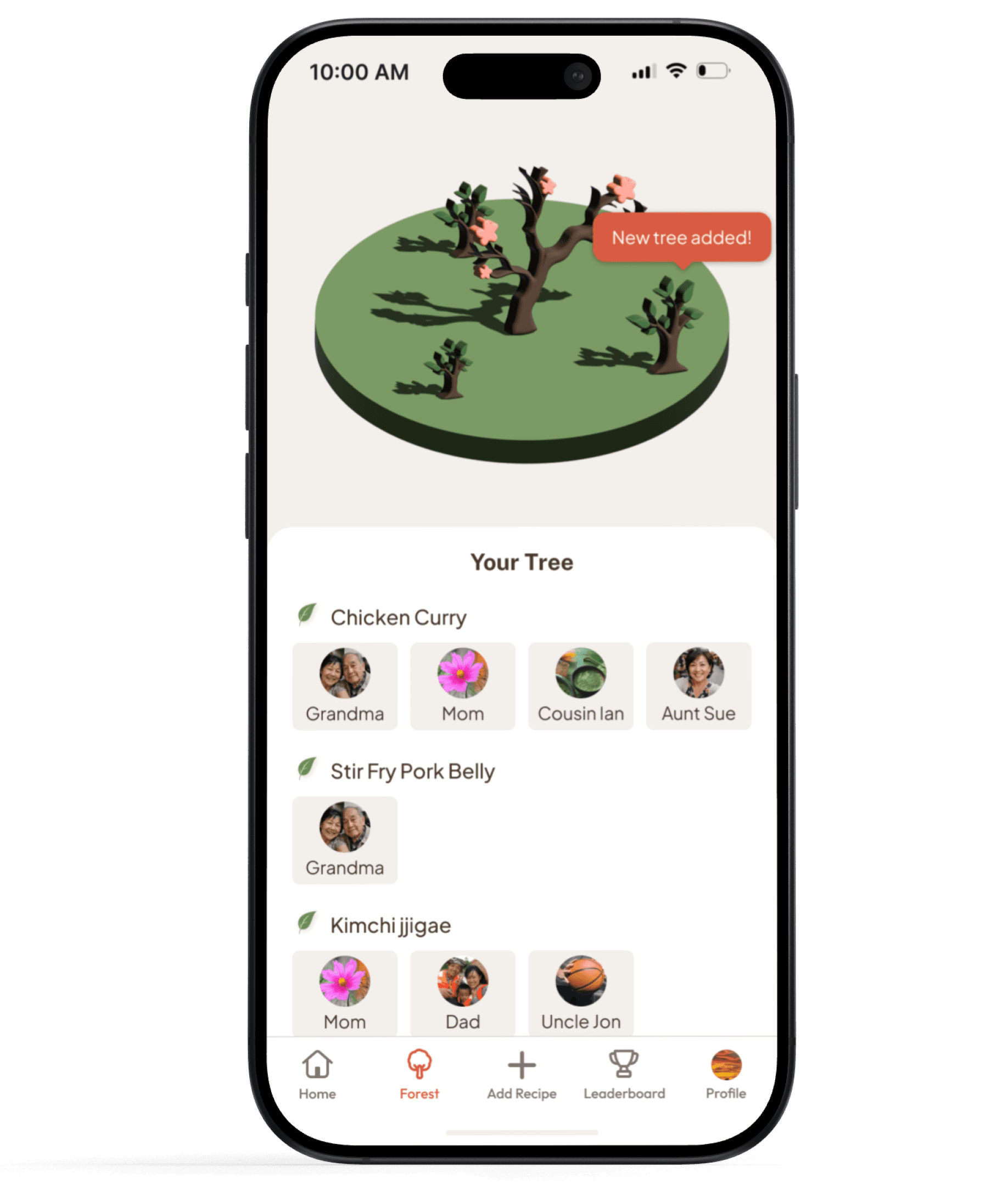
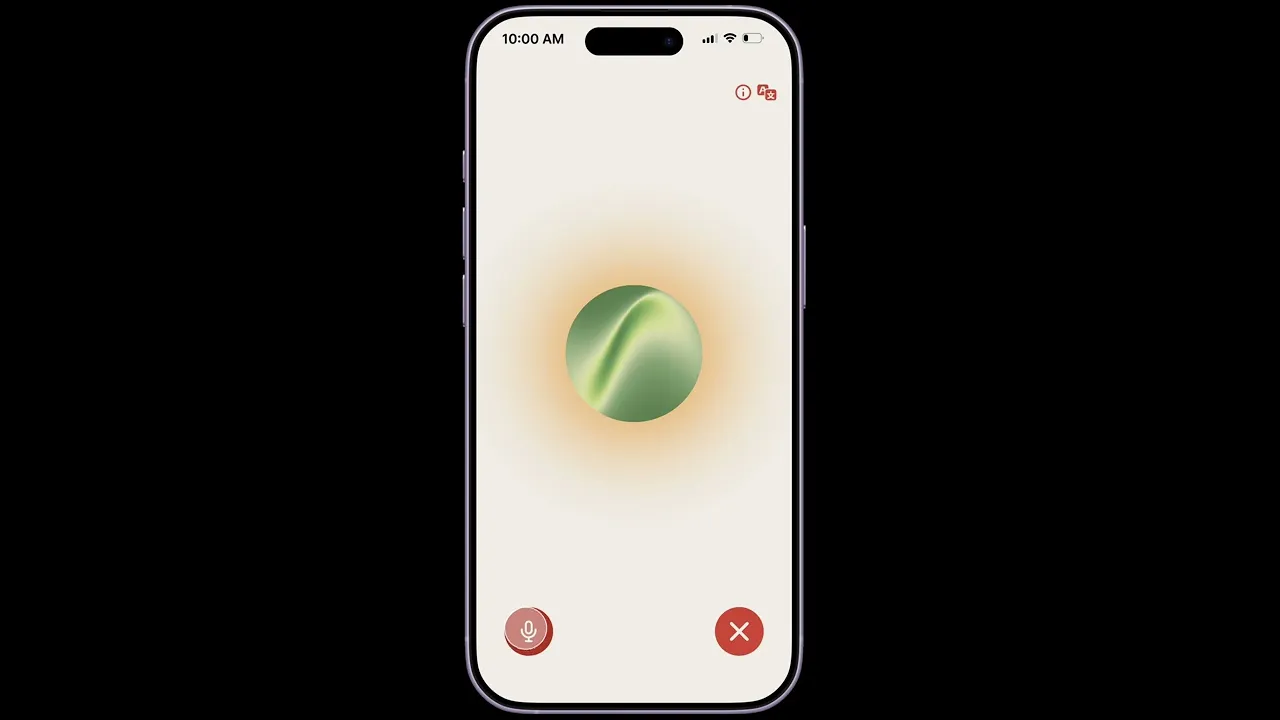
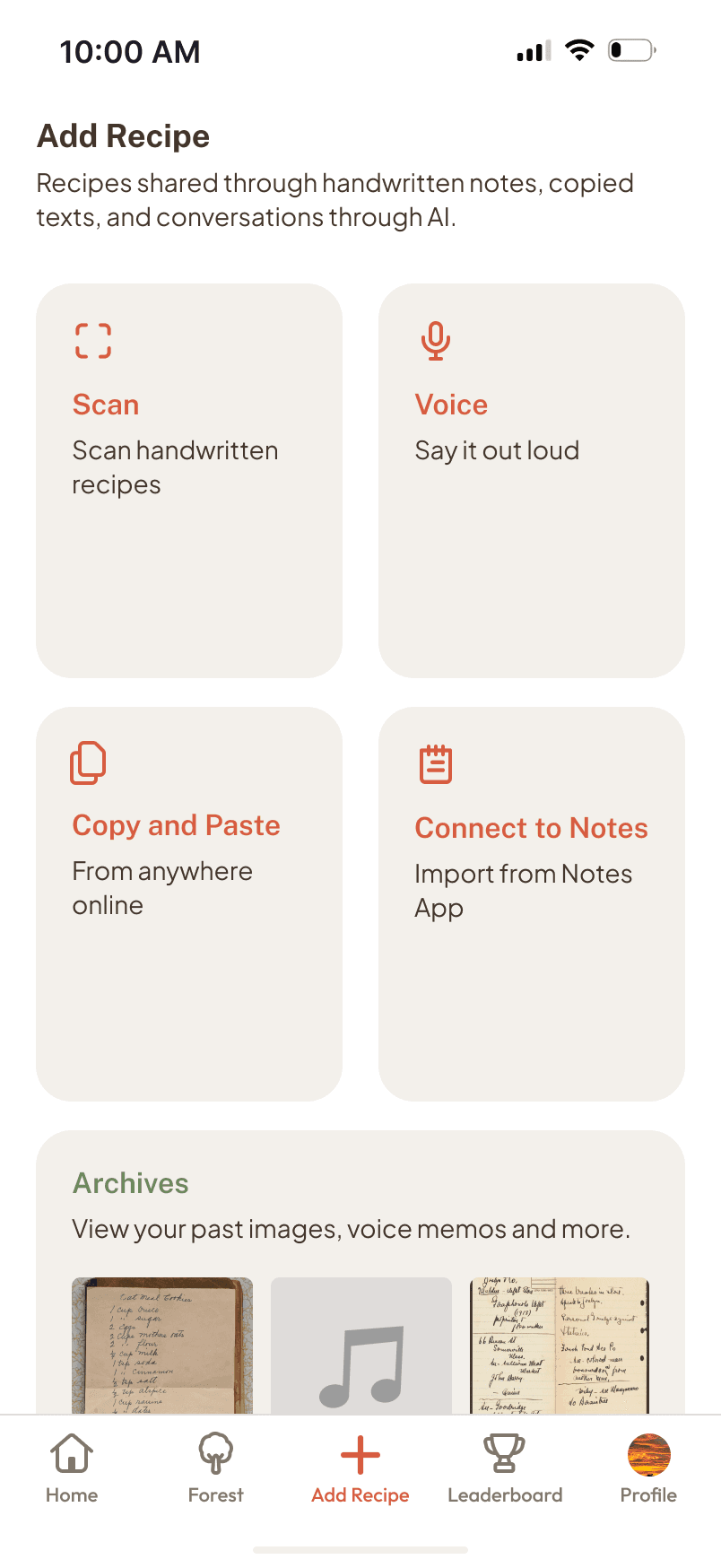
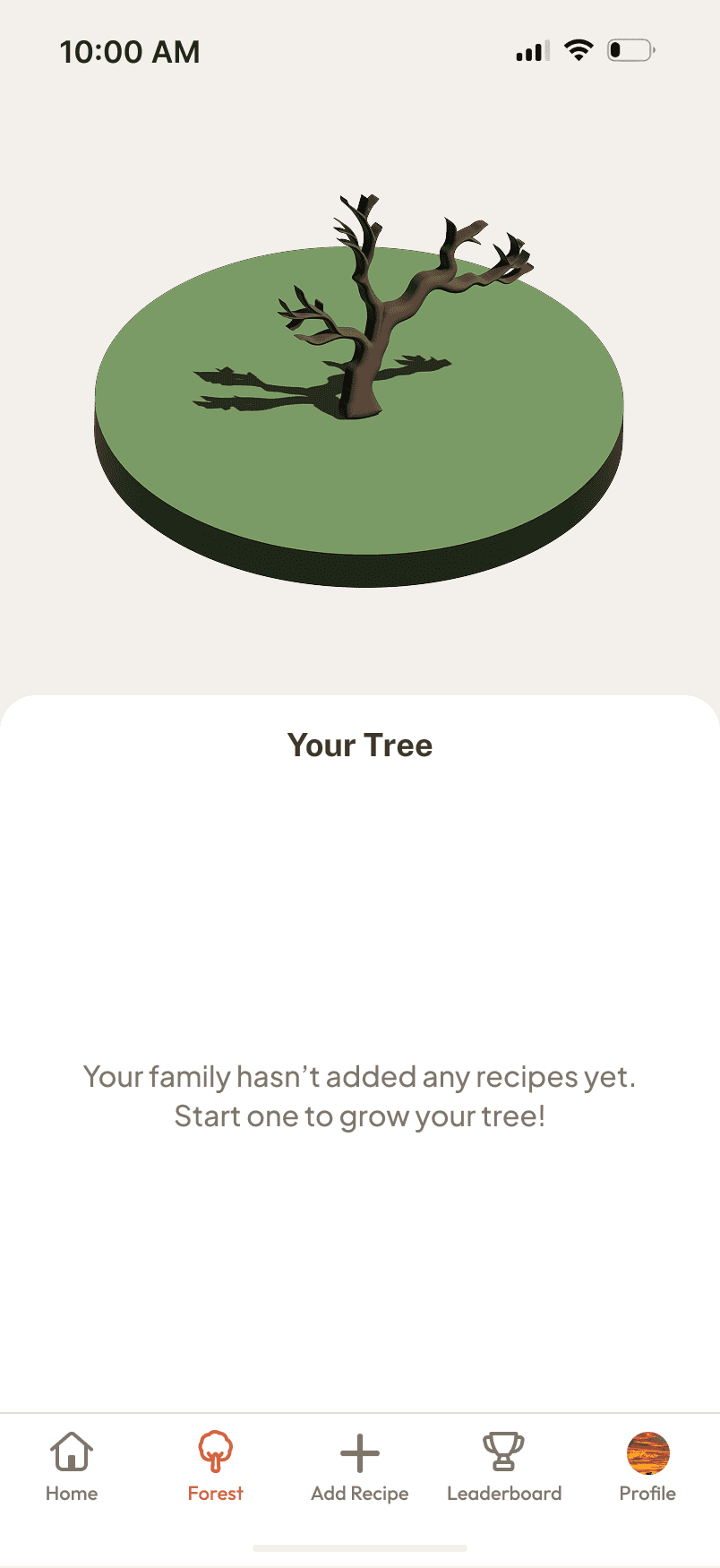
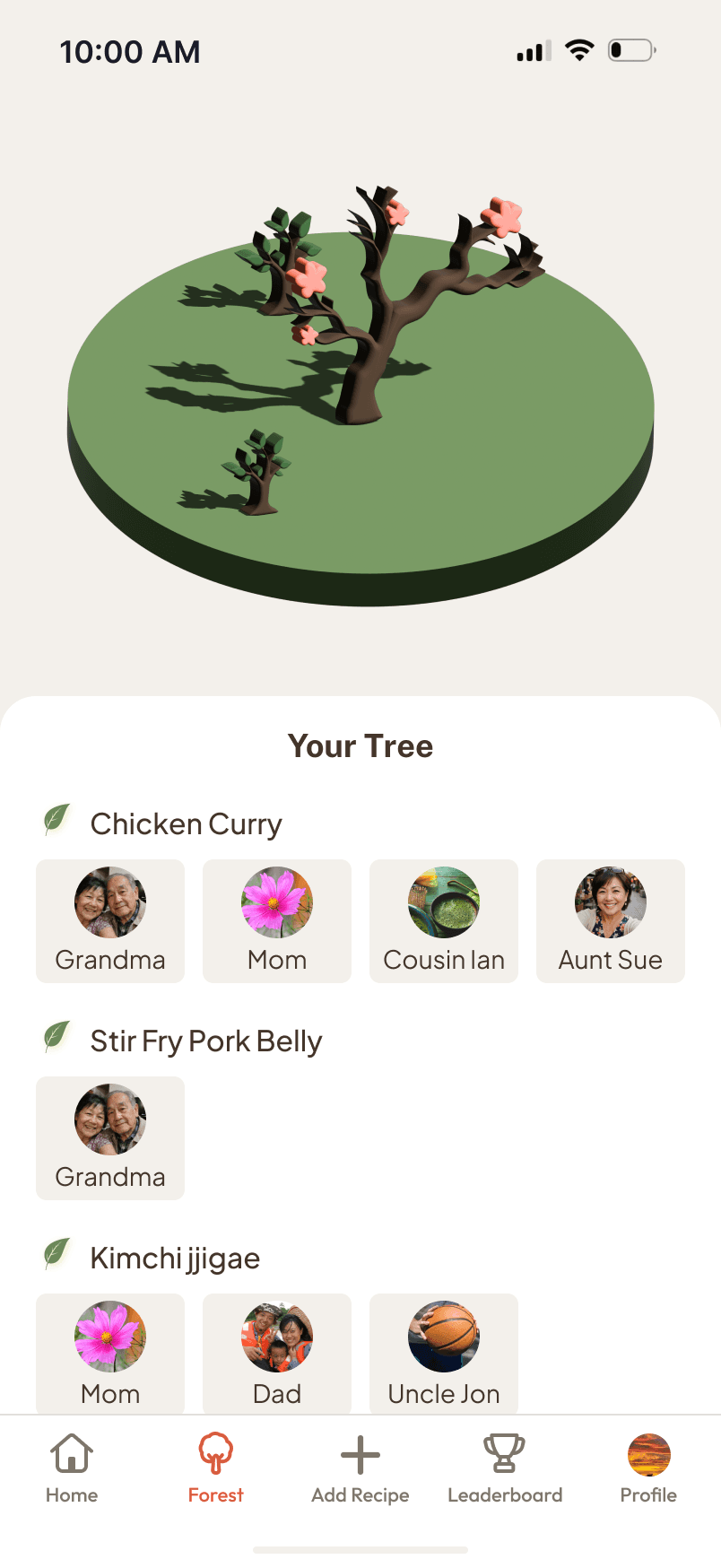
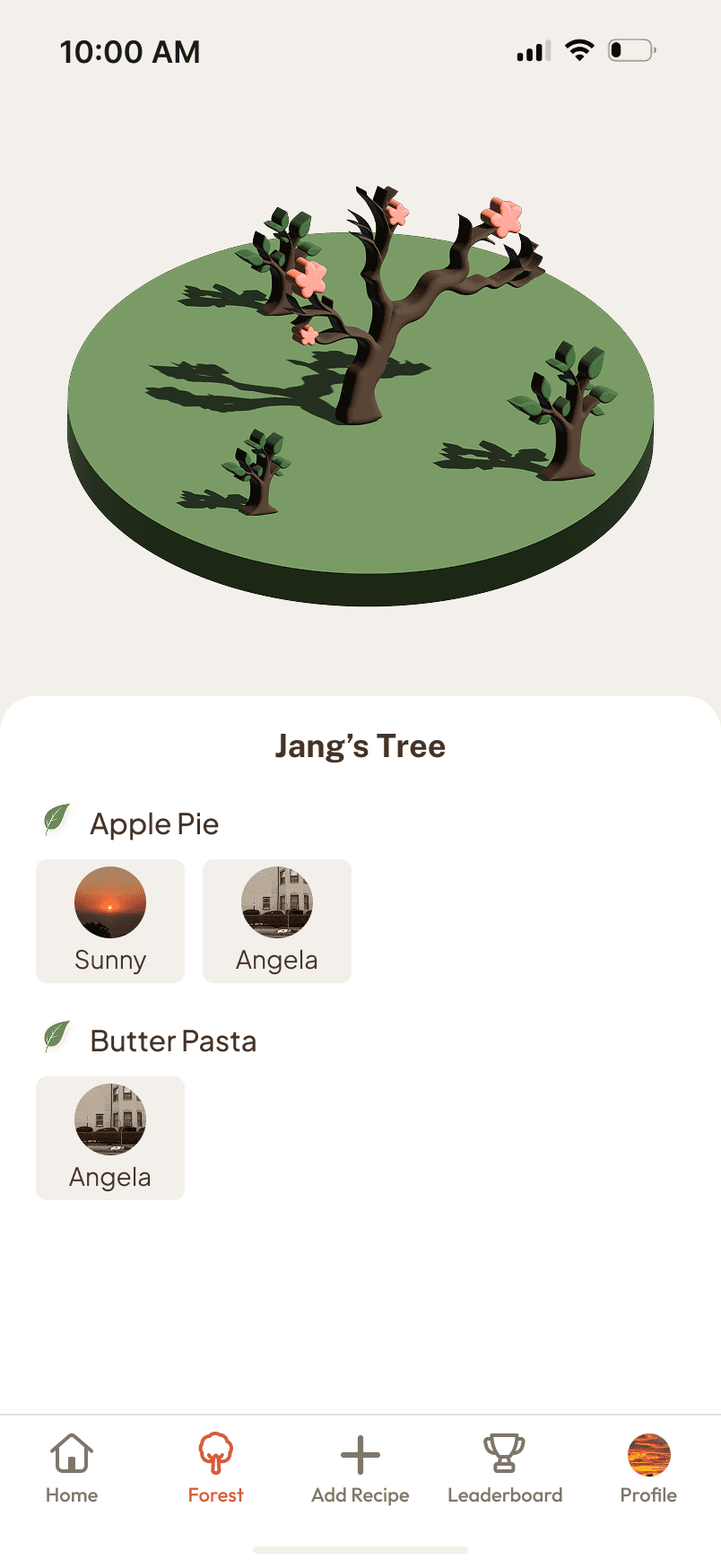
Savor is a mobile app that preserves and shares family recipes across generations. Using AI-powered voice and handwriting capture, it transforms personal recipes into an accessible, digital family archive—framed as a growing forest that reflects shared traditions and memories.
Problem Statement
How might design help younger and older generations learn from one another, share stories, and build meaningful relationships?
Ideation
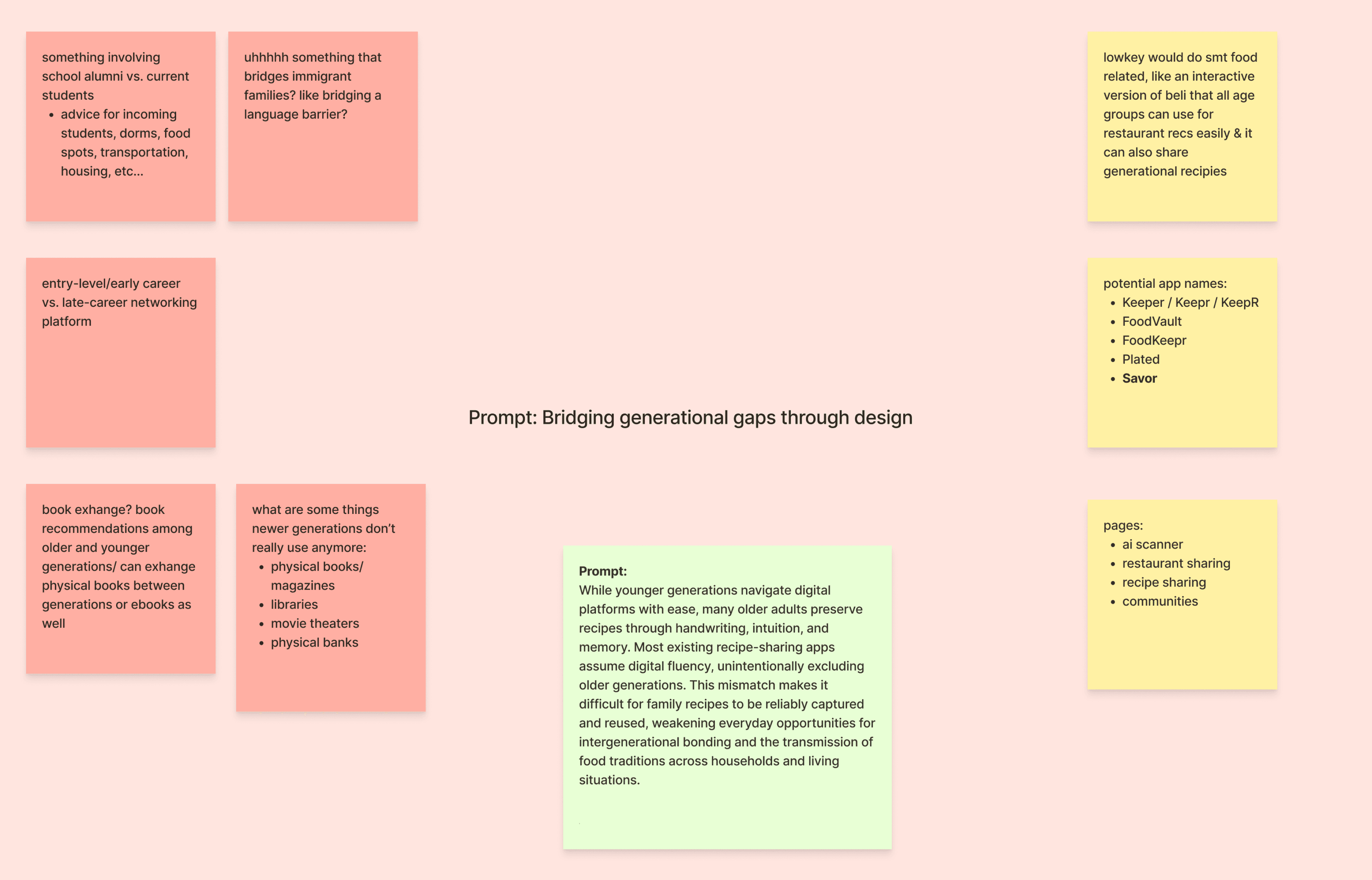
Based on the prompt, our team explored different ways to bridge generational gaps and ultimately focused on family recipes as a shared, cross-generational connection.
Research
Before designing, primary and secondary research were conducted, to understand how family recipes are shared across generations and where communication and documentation styles create friction.
Primary Research: Understanding generational communication differences
Interviews (n=4)
Prioritized with older participants
Captured verbal, memory-based sharing styels
Surveys (n=27) - Google Forms
Emphasized younger participants
Reflected digital-first documentation habits
Survey Results
Receive recipes verbally through conversations than written instructions
70.4%
Recipes live in scatter places
(screenshots, notes app, messages)
55.6%
Re-contact family while cooking due to unclear/missing steps
59.3%
Secondary Research: Competitive Analysis
Pepper
Social recipe sharing
Collaborative collections, community-driven discovery, clean organization
Assumes digital fluency; focuses on sharing rather than preserving story, context, or lineage
Imports from social media, web, screenshots, handwritten recipes
Optimized for collecting online content; limited support for voice-based teaching and experiential nuance
Robust organization, meal planning, shopping lists, cross-platform ecosystem
Designed for efficiency and productivity; not built for family knowledge transfer or storytelling
AI-powered recipe importing
Structured recipe management + meal planning
Platform
Core Focus
Platform
Strengths
Weaknesses
ReciMe
Samsung Food
Pain Points
01
Recipes are shared relationally through voice, memory, and experience
02
Younger generations rely on searchable, structured systems
03
No platform translates experiential sharing into reusable digital formats
User Flow
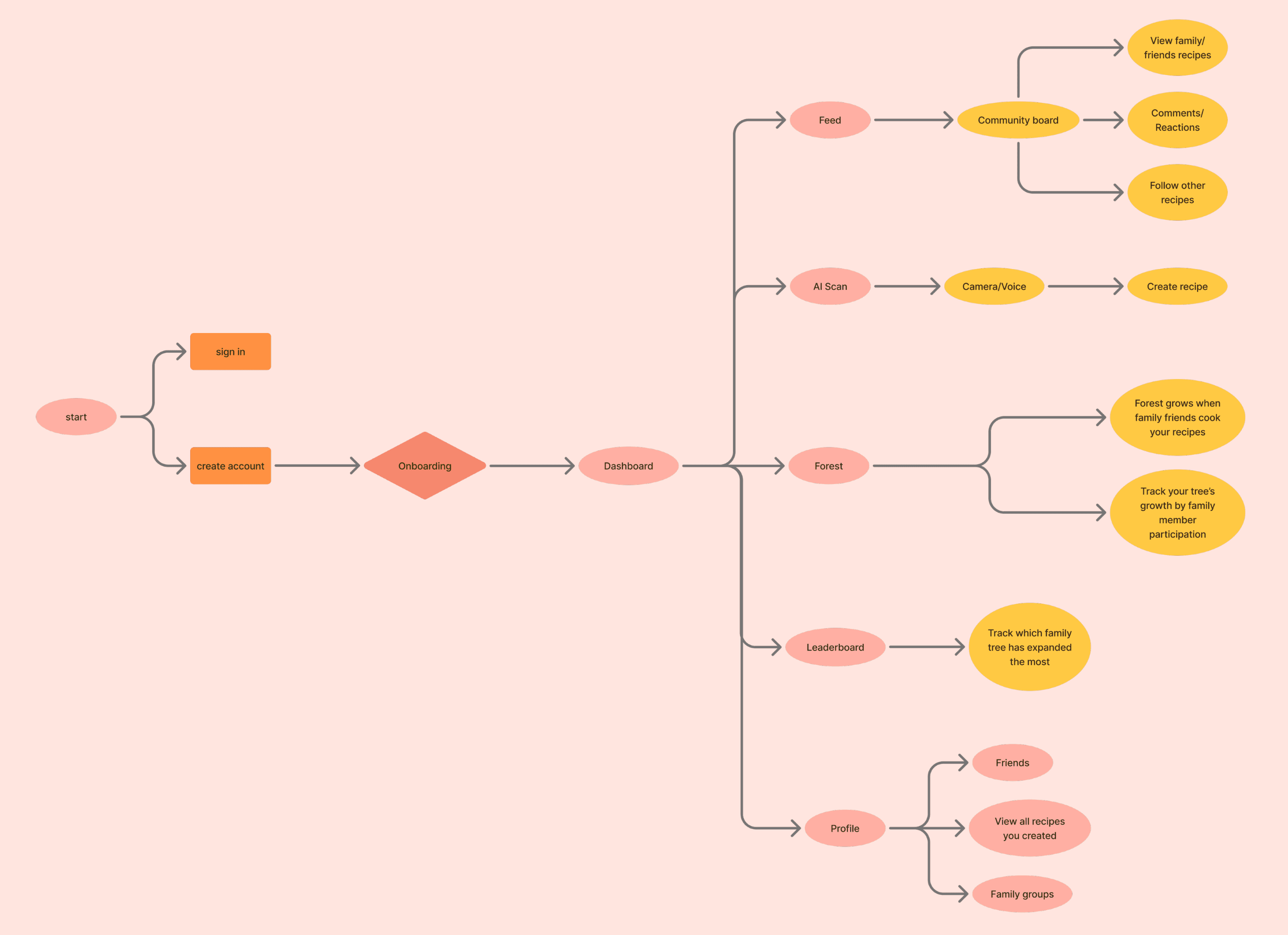
I mapped a user flow for the interface, anchored by distinct onboarding tracks for candidates and voters. Their onboarding choices then route them to a personalized dashboard with the most relevant tools, content, and actions.
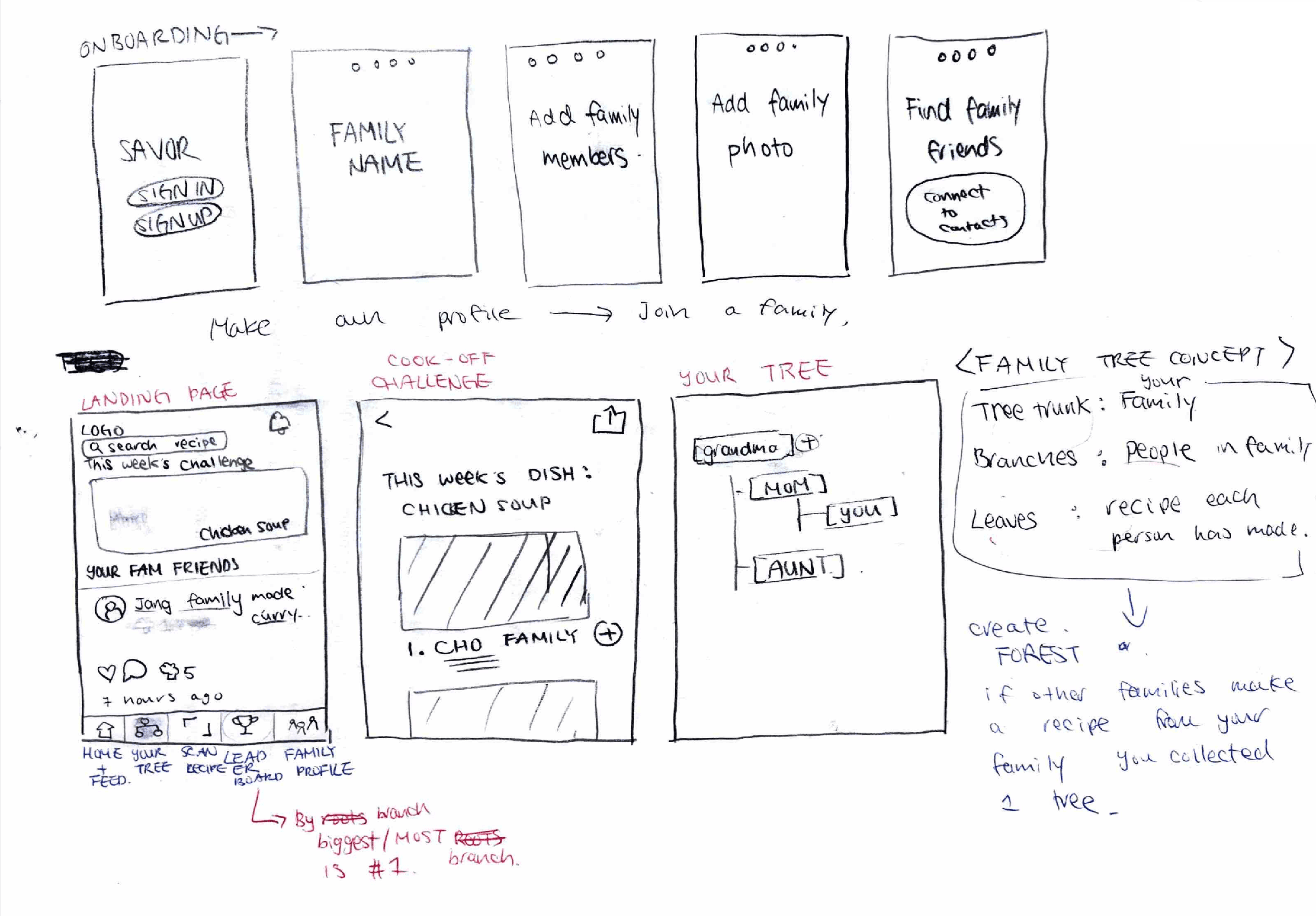
Sketches
These initial sketches guided our final direction, experimenting with how the family tree metaphor could evolve into a visual system of leaves, trees, and forests.
Designs
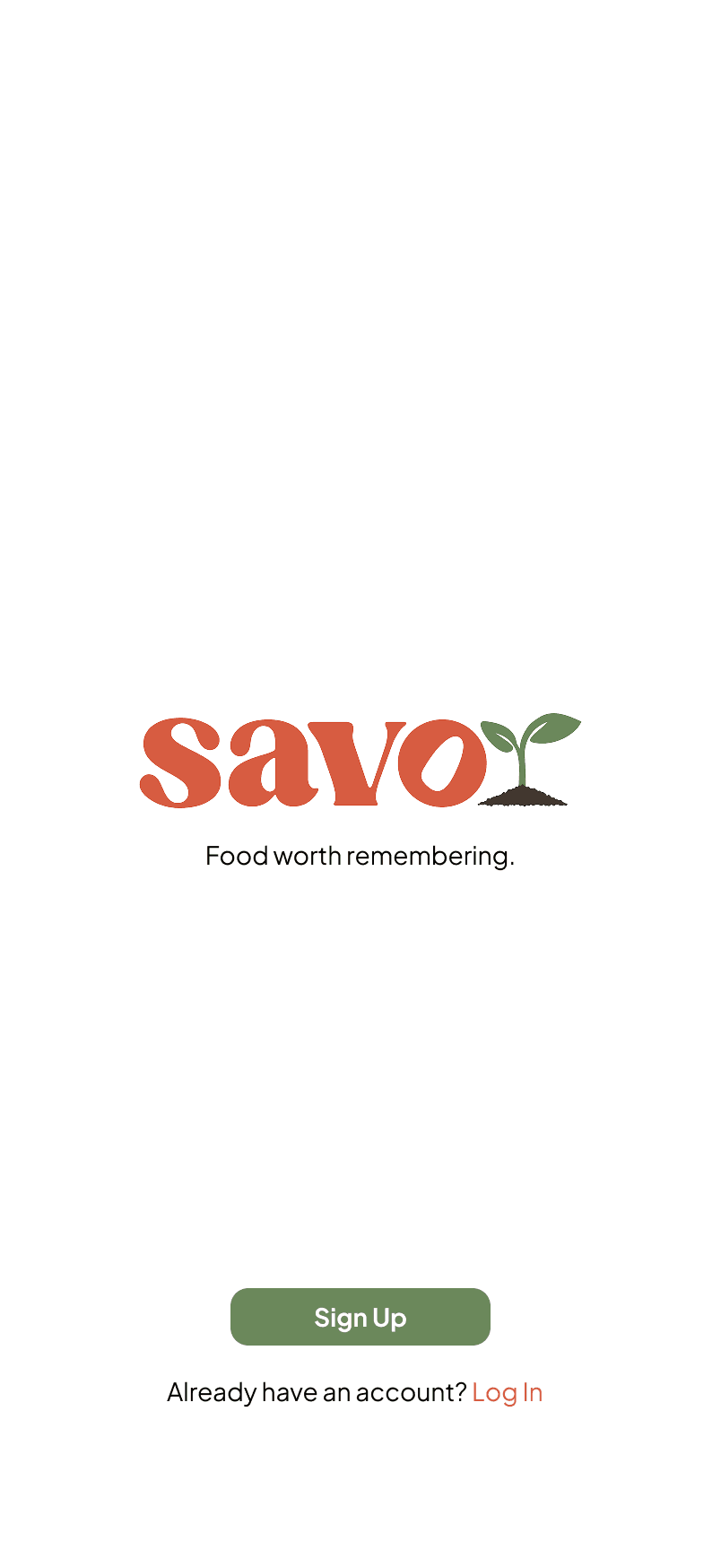
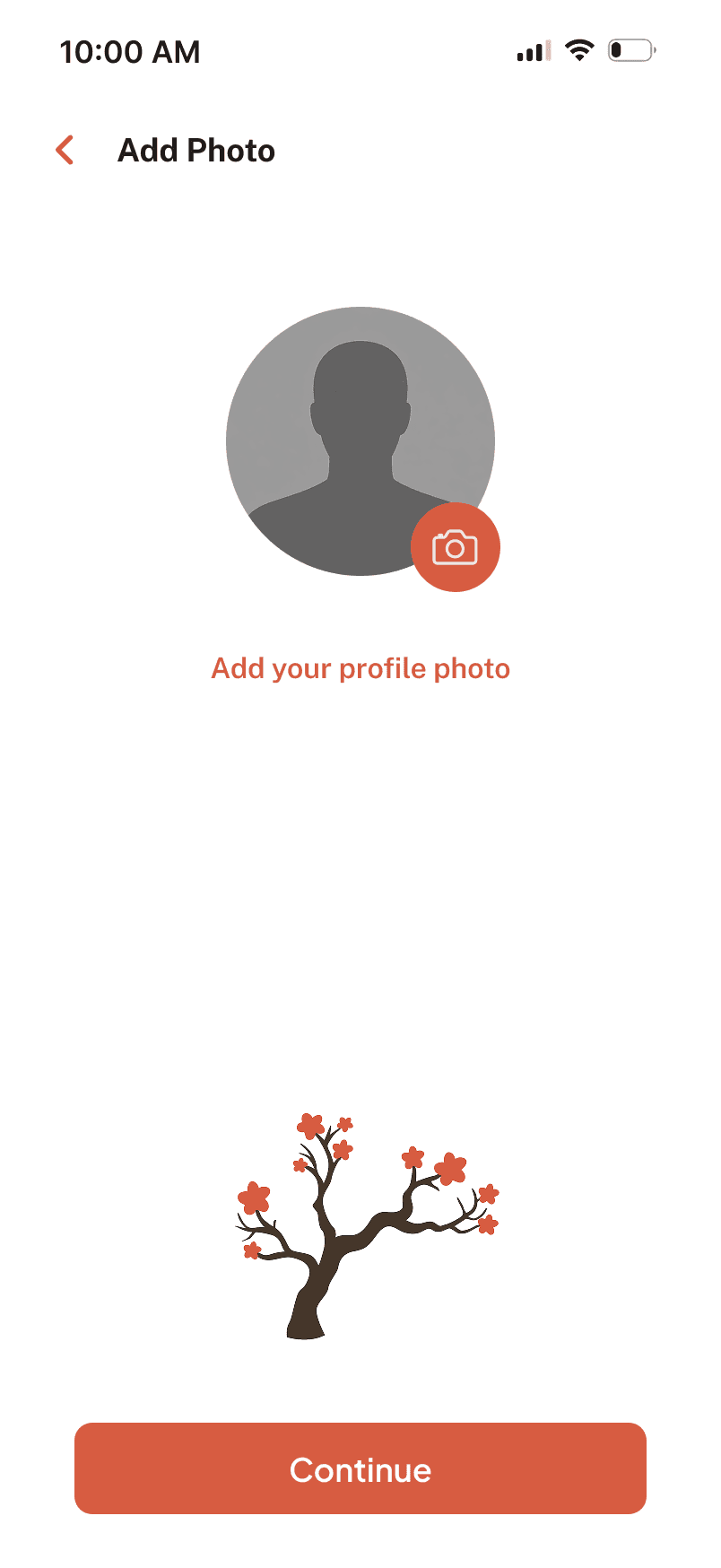
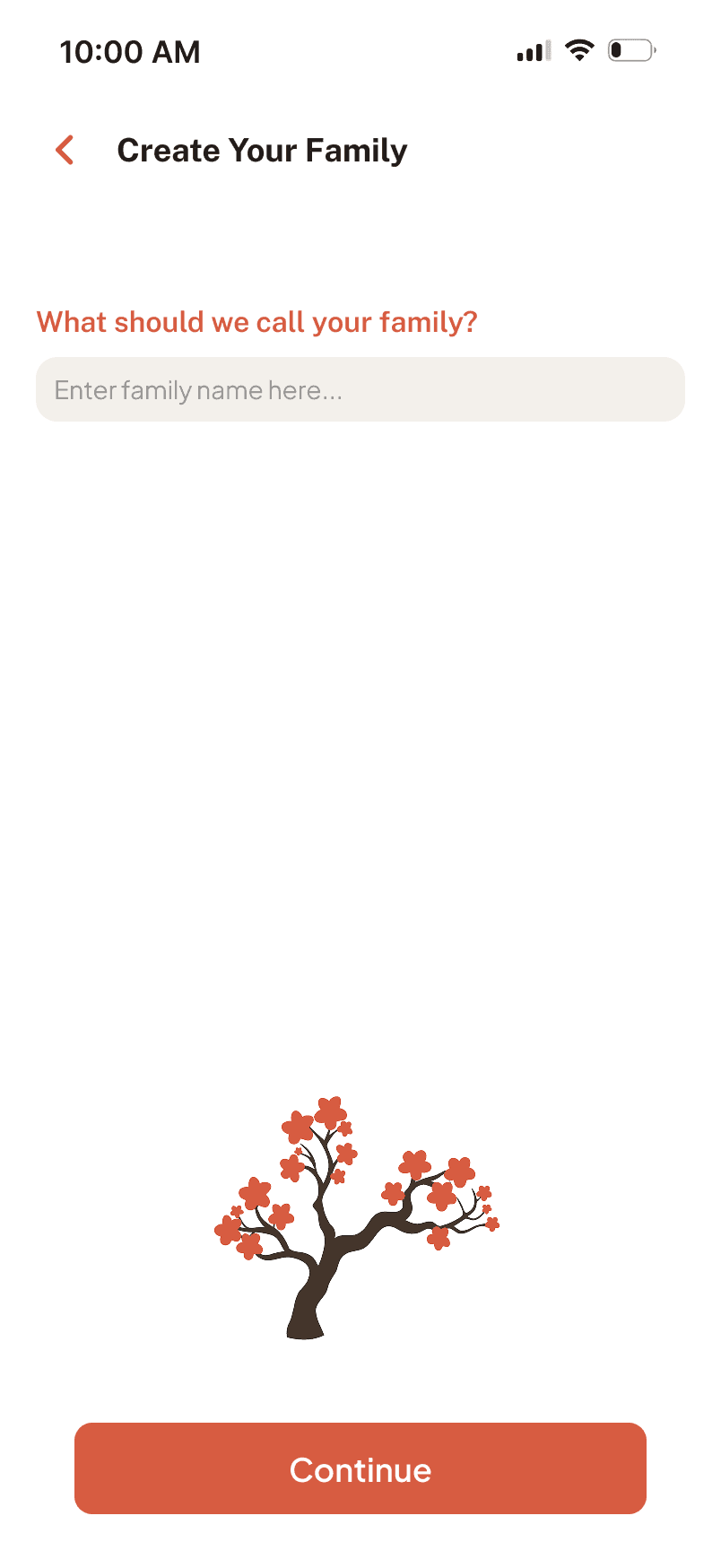
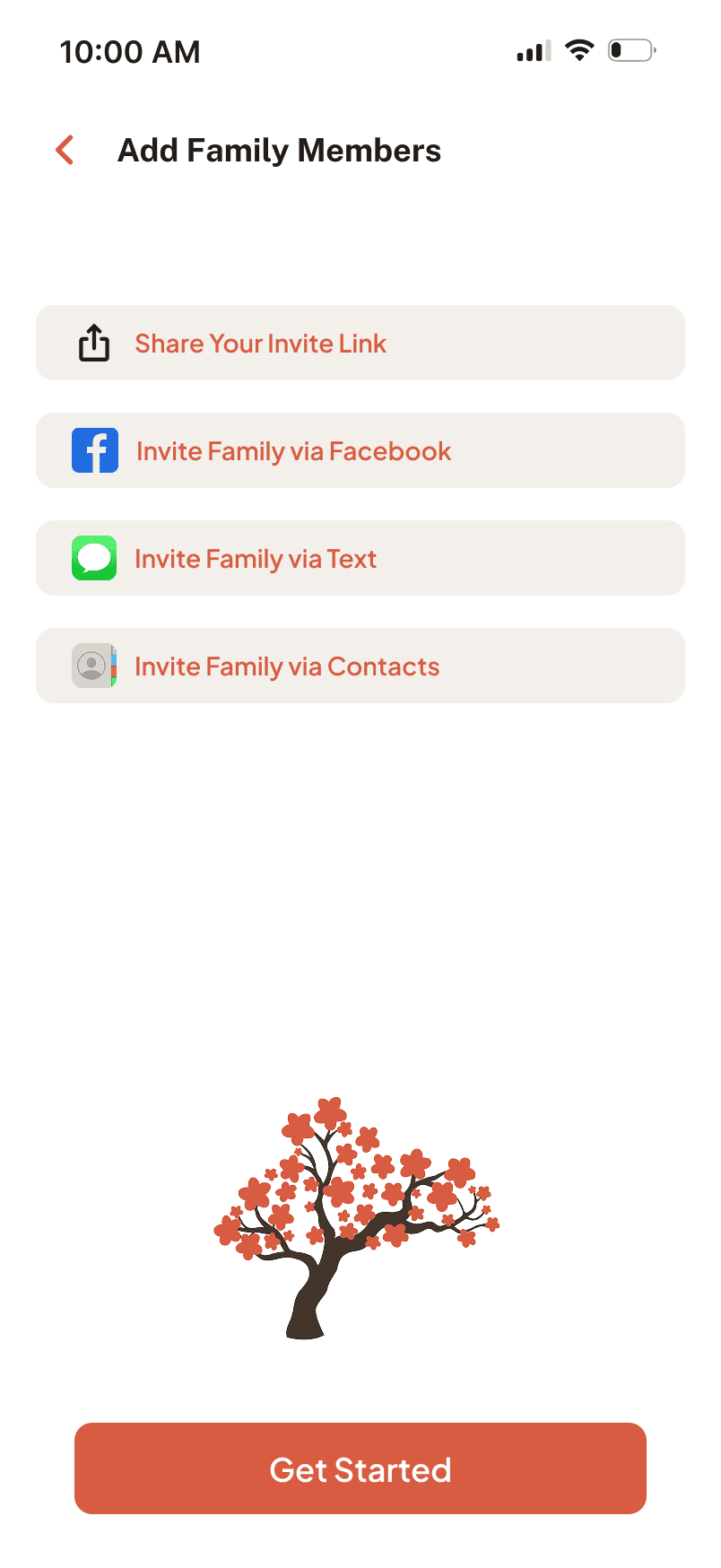
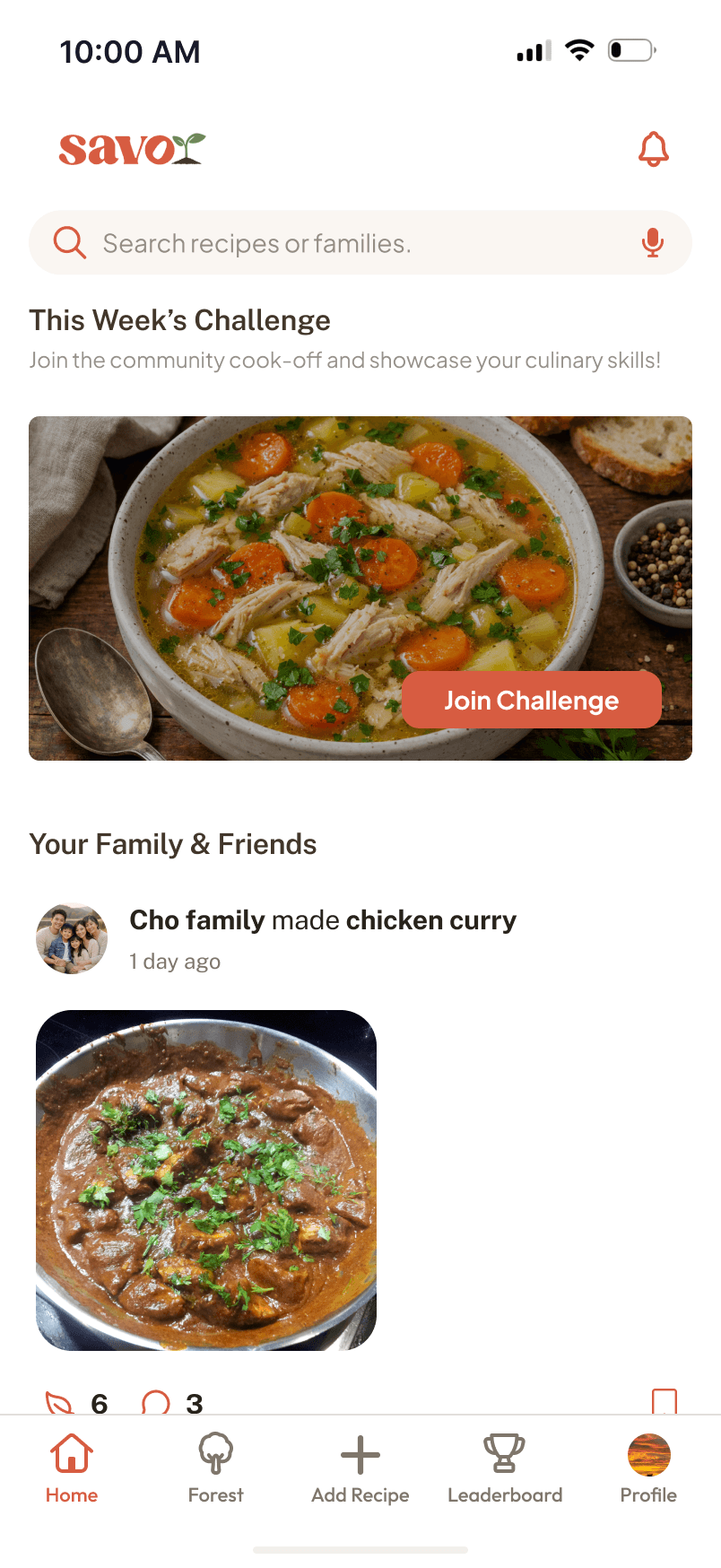
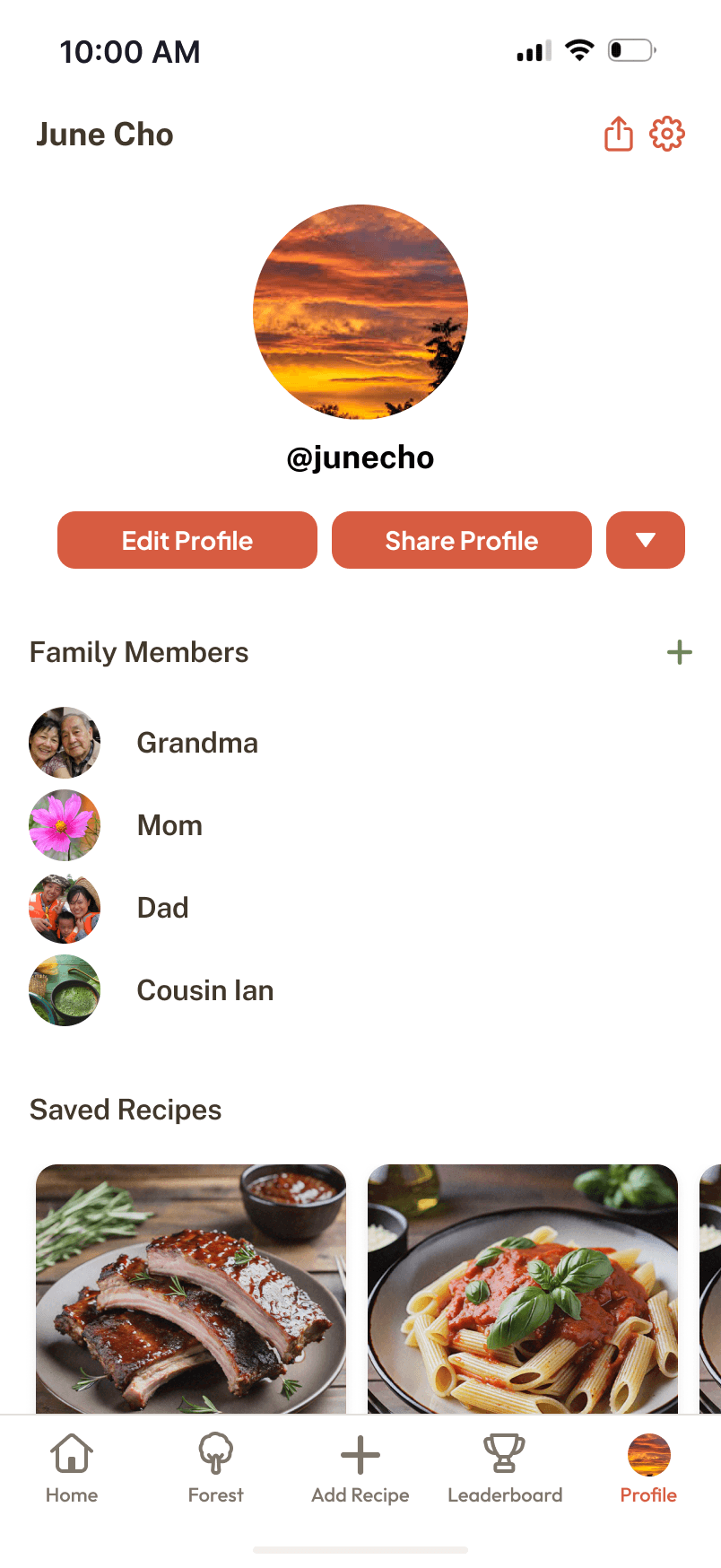
The following screens present our team’s final designs, focused on delivering the product’s key features and primary user experience.
Onboarding
Core Feature Pages
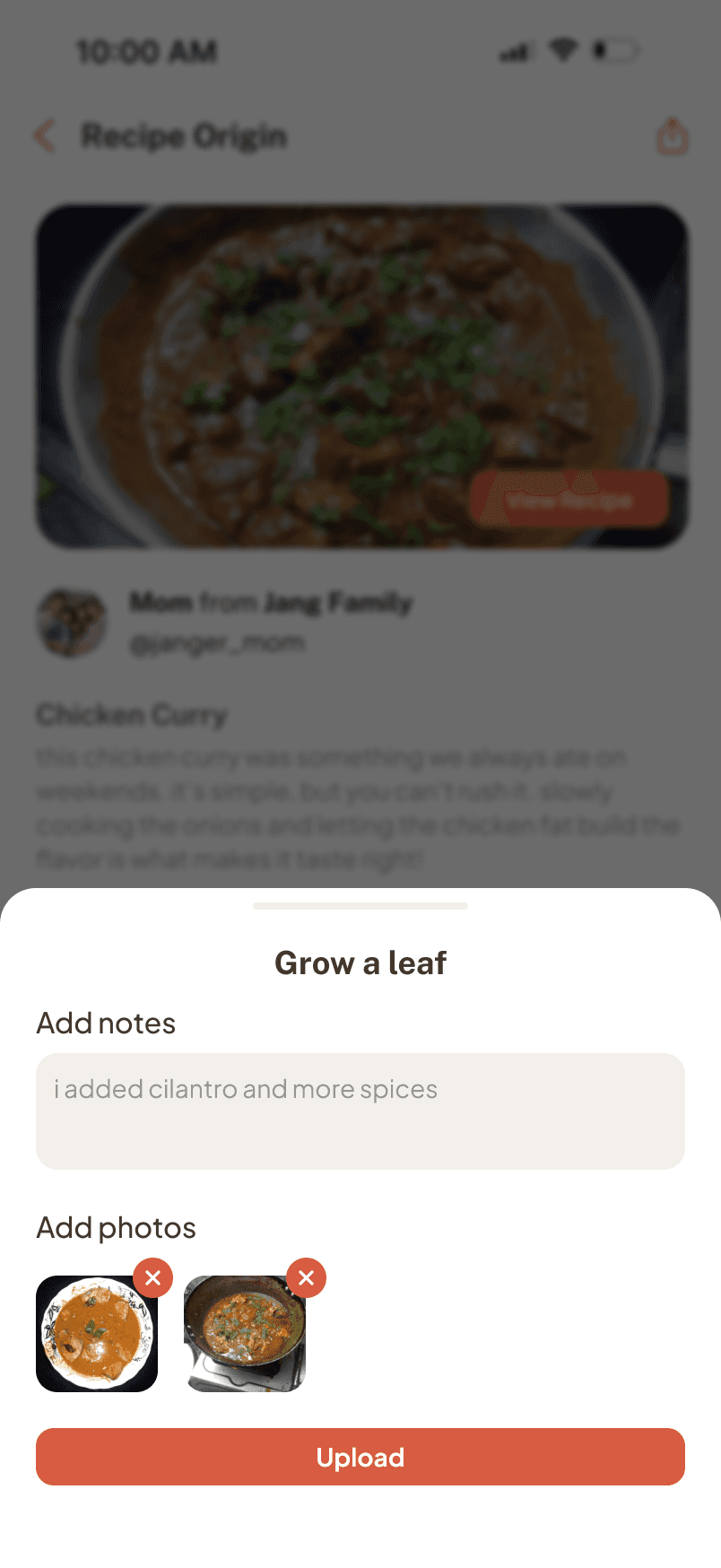
Growing a leaf
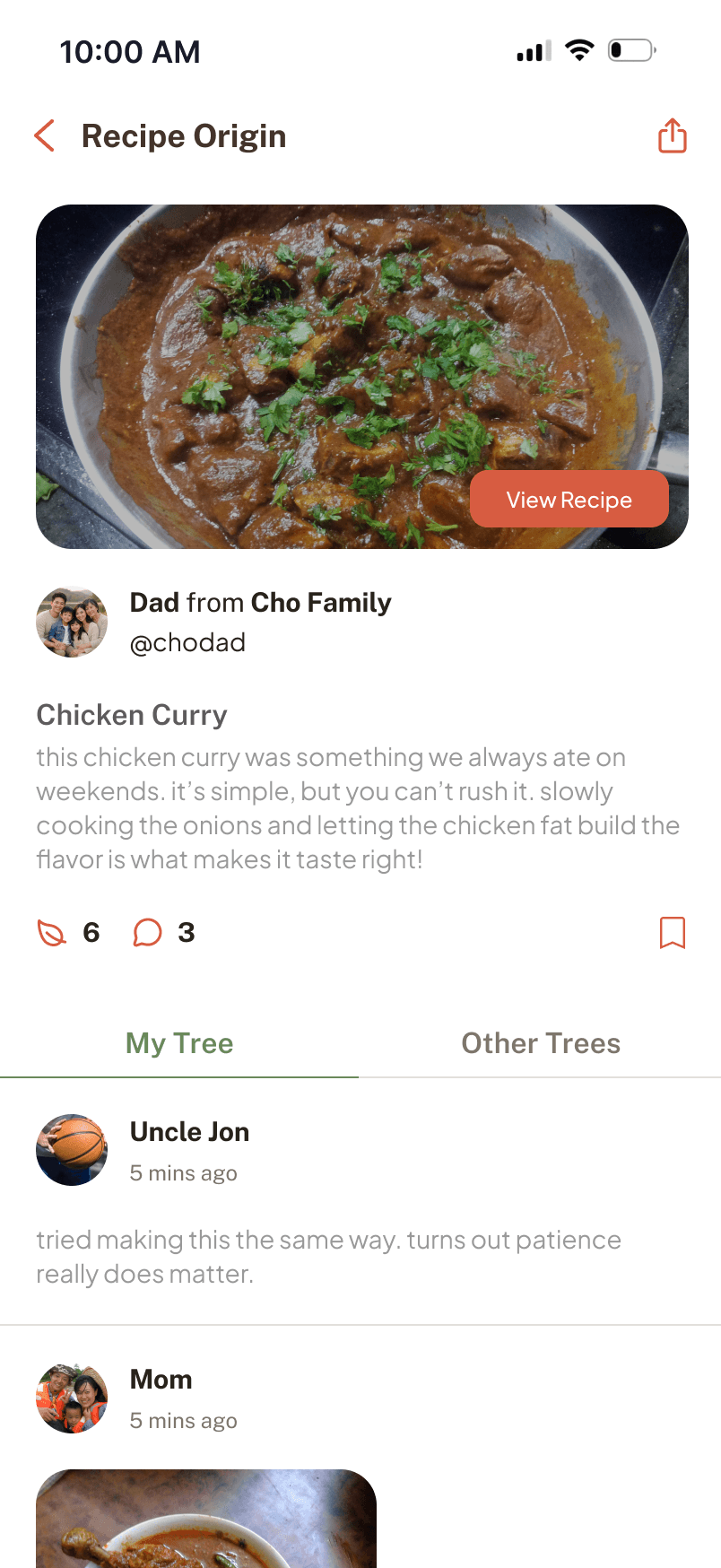
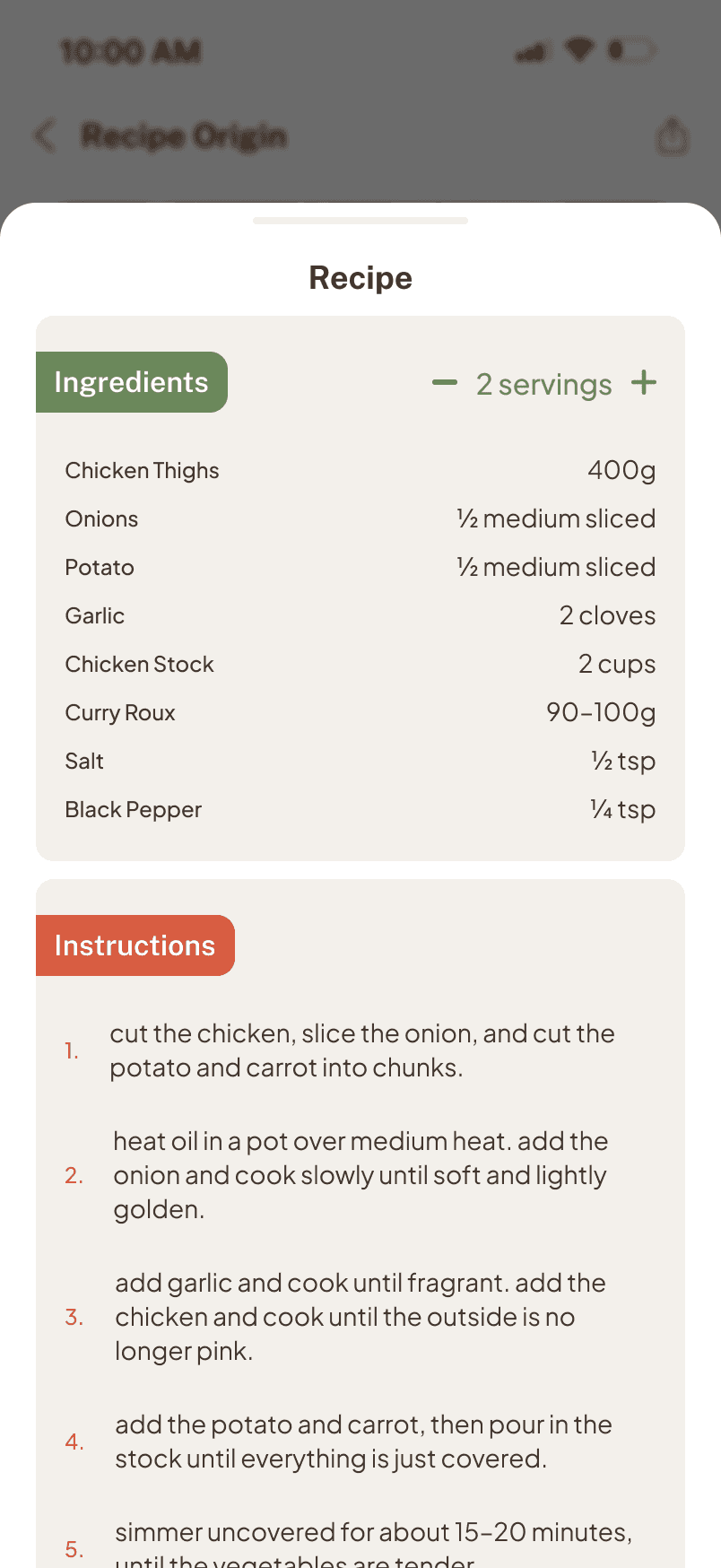
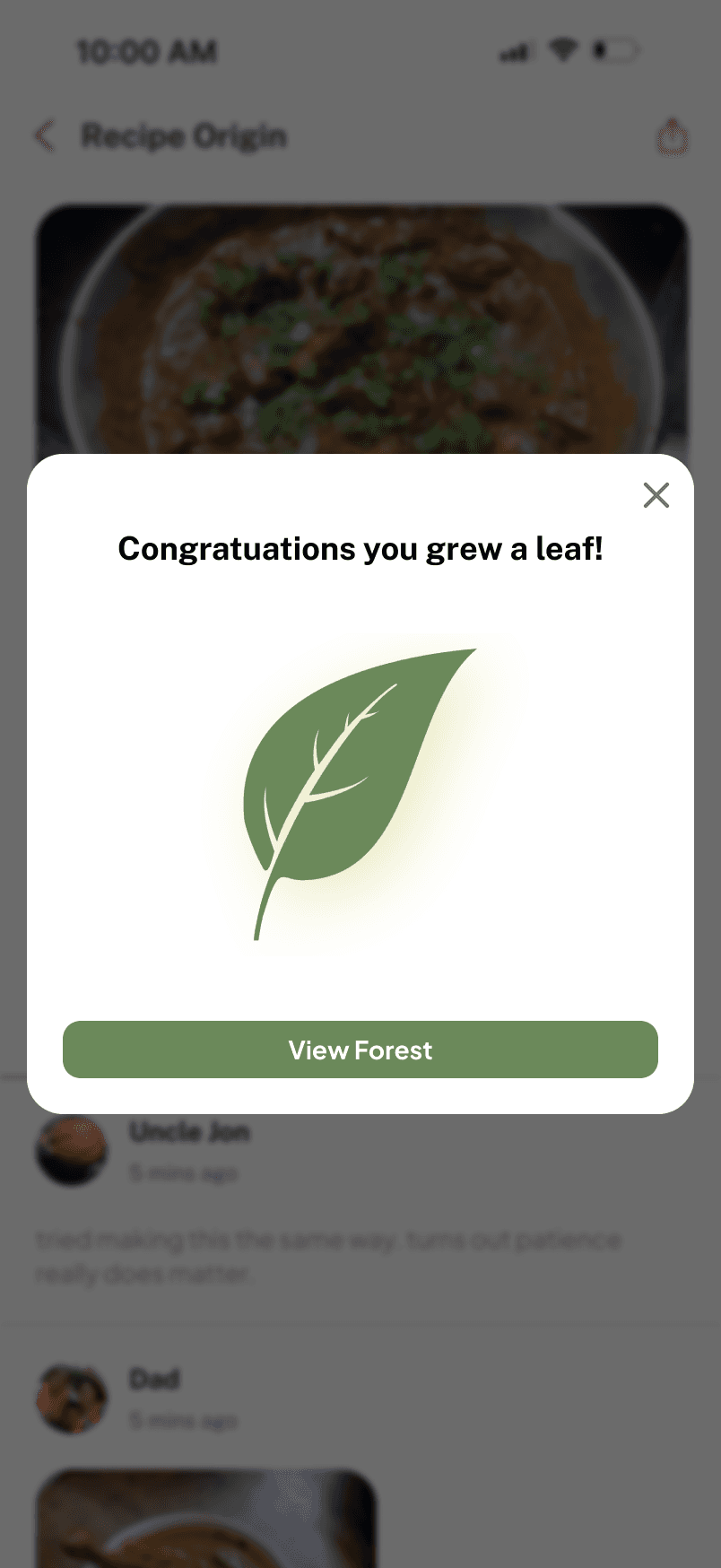
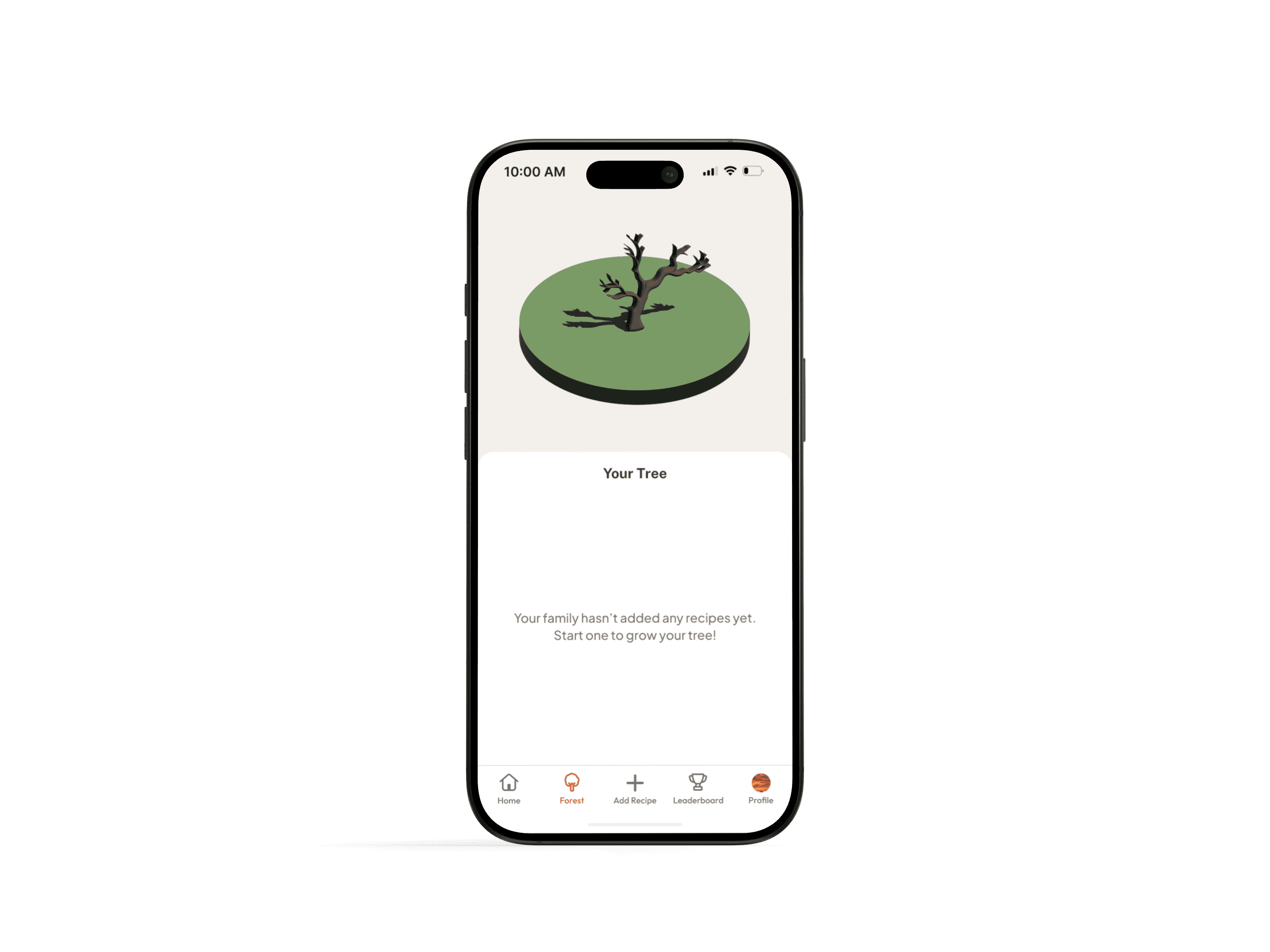
Each Recipe Adds a Leaf to Your Tree
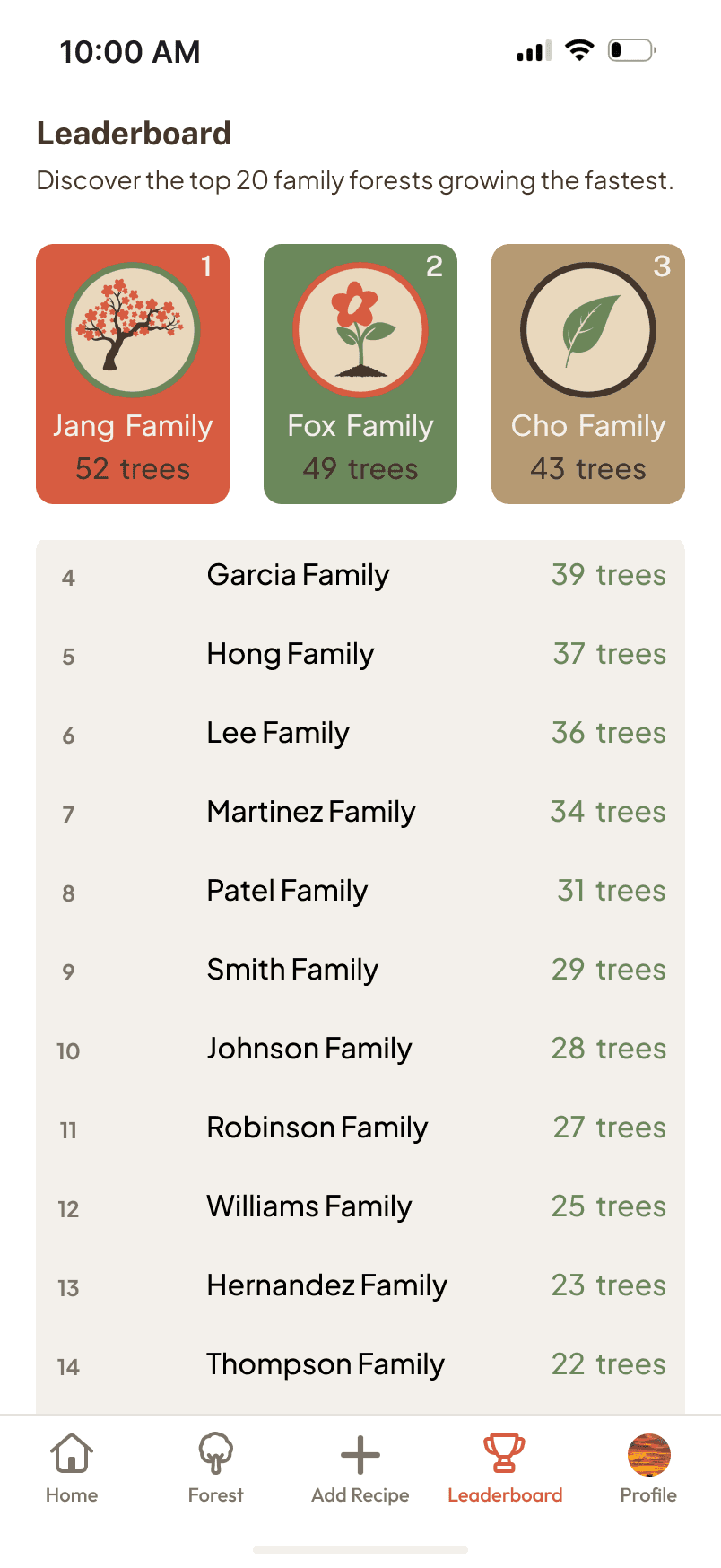
Building Your Forest
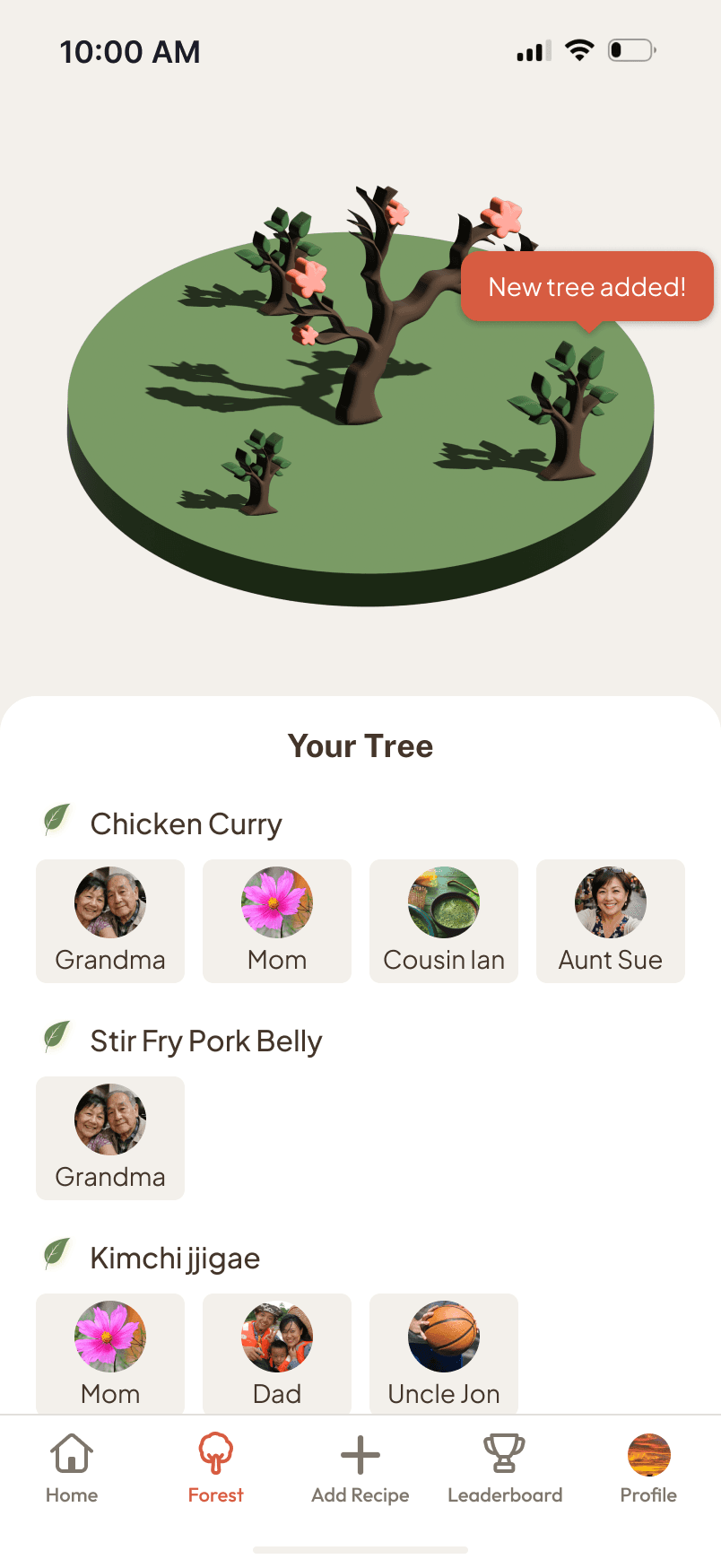
Prototype on Figma
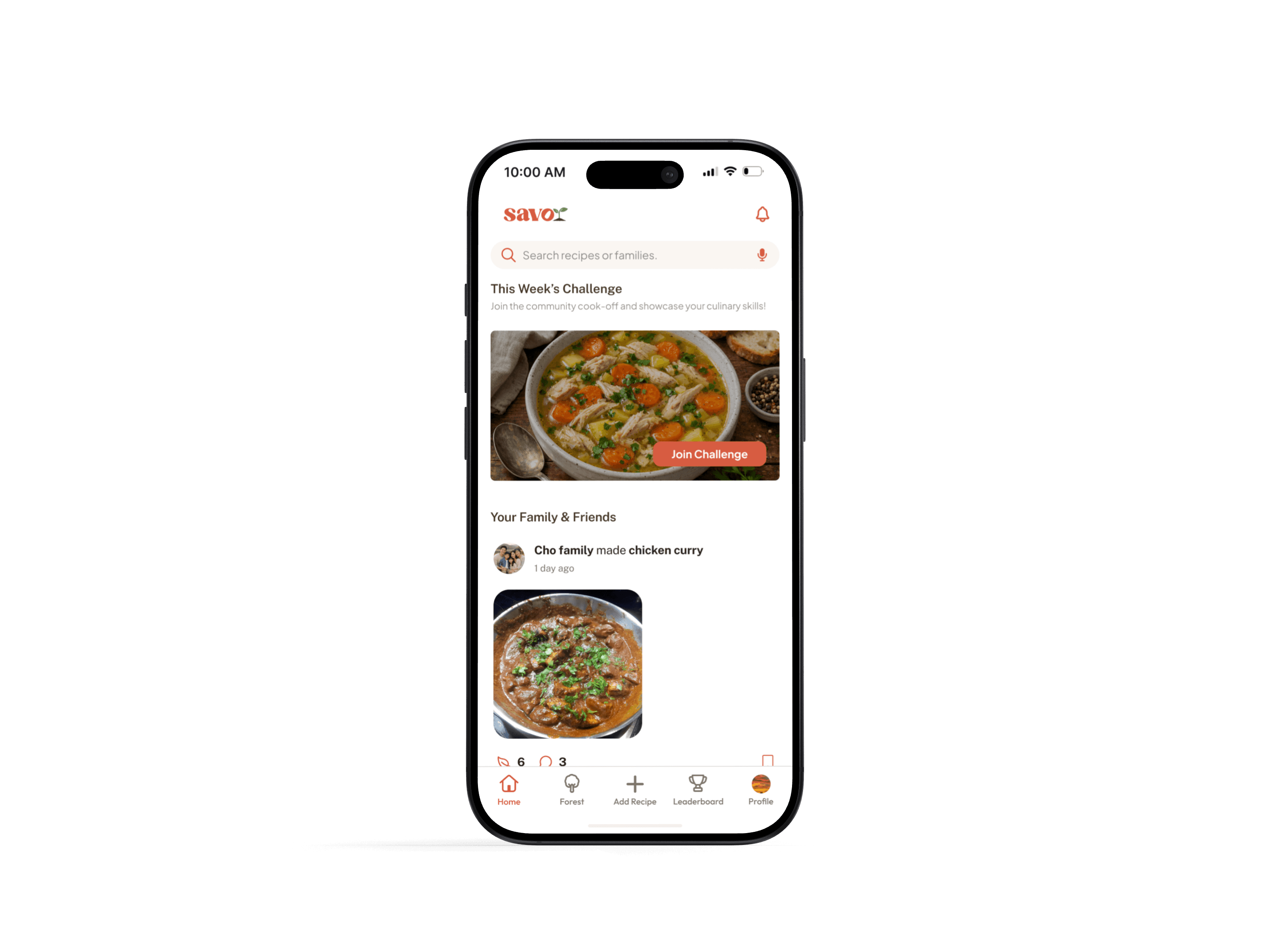
This Figma prototype was created during the hackathon to visualize the intended look and feel of the app, offering a realistic preview of the user experience.
Prototype with Cursor
After the design-a-thon ended, I wanted to bring the concept to life beyond static mockups and make it accessible as a live web experience. I began experimenting with Cursor to translate the design into code, which pushed me to think more deeply about interaction logic, component structure, and how design decisions hold up in a real product environment. Through this process, I gained hands-on experience bridging design and engineering while refining the system to feel cohesive and production-ready.
GitHub Repository: https://github.com/junecho67/savor
Live Prototype: https://junecho67.github.io/savor/
Learnings
This design-a-thon tested how quickly I could iterate, collaborate with others, and synthesize complex ideas into a cohesive solution. Working under time pressure forced me to prioritize, adapt, and think critically about every design decision. Our team dynamic was especially strong because each of us took clear ownership of our roles. Angela led visual identity, designing the logos and brand assets, while I focused on crafting the product interfaces. Yuju drove the user research, ensuring our decisions were grounded in real user insights. The clarity in our roles allowed us to move efficiently while maintaining alignment and quality.
Contact
Tel: +1 (857)488-8411
Email: yejune.cho7@gmail.com
Thank you for taking the time to view my designs!